
Start an Onslow People Search
A good Onslow County search begins with the fact already known, then moves to the record built around that fact. A full name fits the deed, court, voter, business, and professional indexes. A street address belongs first in the tax search and GIS map. An old phone number or former address calls for the library’s phone books and reverse directories. Family events lead to vital records, estates, obituaries, and archival files.
Do not treat the first match as proof. Military moves, middle initials, spouse names, rural routes, and base addresses can separate people who share a name. Compare dates and at least one other identifier. The most recent filing may locate a present contact, while an older deed or city directory can connect the same person to a past address.
- Search the name in the county deed index and note each role, date, book, and page.
- Check eCourts by party name, location, case type, and filing period.
- Use the tax portal and GIS when an owner or street address is known.
- Move to voter, business, license, library, or estate records when the purpose calls for them.
- Ask the correct custodian for an older, restricted, or non-digital file.
Note: A mailing address can support a trail, but it does not prove that the named person lives at the property.
Onslow Records Desks by Search
Onslow County does not place every people record in one office. The Register of Deeds keeps land instruments and local birth, death, and marriage records. The elected Clerk of Superior Court keeps civil, criminal, divorce, estate, and special-proceeding files. Tax and GIS staff connect owner names with parcels and mapped places. Jacksonville’s City Clerk keeps municipal material such as board records, ordinances, minutes, and cemetery administration.
That split matters in North Carolina. A “county clerk” request for a marriage certificate belongs with the Register of Deeds, not the court clerk. A request about an estate belongs with the Clerk of Superior Court. The detailed rules for fees, exemptions, and general requests are set out with the Onslow County public records system.
Jacksonville City Clerk
815 New Bridge Street
Jacksonville, NC 28541
910-938-5224
Search Onslow Deed Records
The Onslow Register of Deeds eSearch is the strongest local name index. Choose “Sign in as a Guest” when no account is needed. Quick Name and Advanced Name searches find indexed parties. Property, book and page, file number, date range, pre-1976 dates, and Certified Dates supply other routes. A grantor transfers an interest; a grantee receives one. Their roles help distinguish a sale from a lien, deed of trust, power of attorney, or other filing.
The official Onslow eSearch entry shows the guest and account paths. The screen pictured here is the starting point, not the complete historical collection.
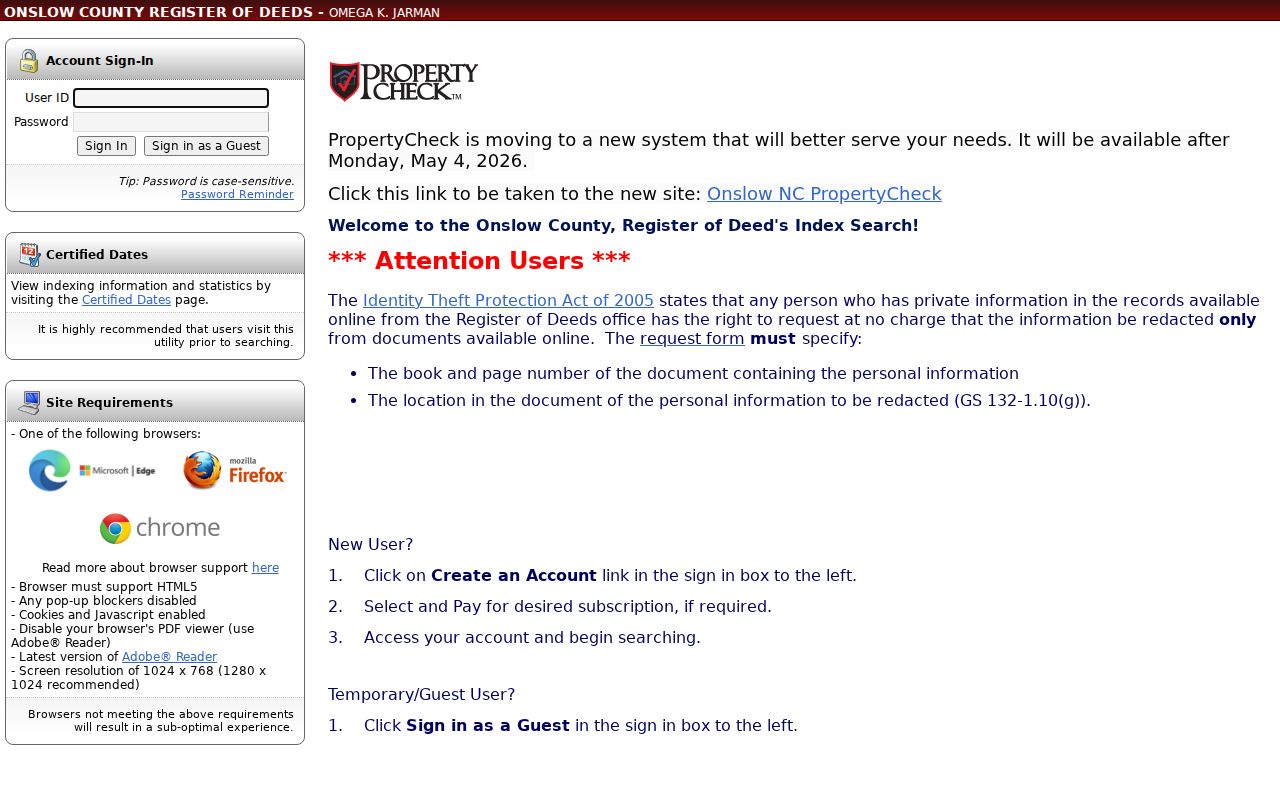
Use Certified Dates before assuming that a recent filing has reached the index. The pre-1995 real-property web series begins in 1977, and the consolidated series begins in 1995. Yet the deed books themselves date to 1734. A missing web result may require the counter, older grantor and grantee books, State Archives microfilm, or library holdings.
| eSearch route | Best use | What to record |
|---|---|---|
| Quick or Advanced Name | Known person or business | Role, instrument type, date |
| Property | Known land description | Book, page, indexed parties |
| Book/Page or File Number | Known citation | Image and certification status |
| Certified Dates | Coverage check | Last certified date by series |
Note: A missing name in the 1977-forward web index does not rule out an instrument preserved in Onslow County’s older deed books.
Trace Onslow Property Records
An address can become a name through the Onslow Tax Bill Search. Search by property address, owner last name, owner first and middle name, account number, parcel ID, alternate parcel ID, or tax year and bill number. The result may show the assessed owner, situs address, mailing destination, bill status, value, legal-description clues, and parcel links. Situs means the physical location. The mailing address is where the tax bill goes, and it may belong to an estate, trust, company, or nonresident owner.
The county tax owner search accepts both names and property addresses. Its form illustrates why an address-first search can uncover an owner even when the name is unknown.
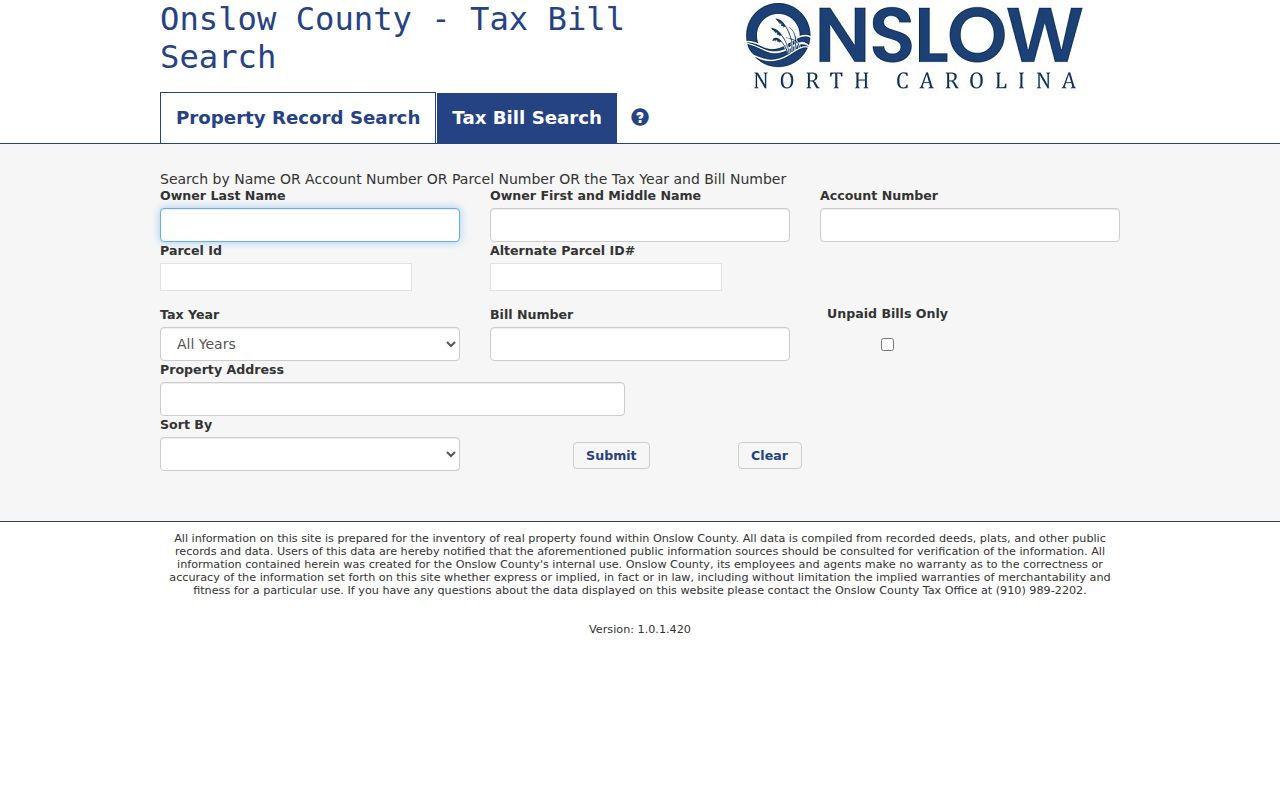
Carry the parcel ID into GIS, then use deed citations to verify title. The tax office itself says its inventory derives from deeds, plats, and other public records. It should not replace those sources. Ownership changes can also take time to move through the mapping and tax systems.
Search Onslow Court Records
Onslow District and Superior Court cases now run through the statewide eCourts Portal. Onslow joined the system on February 3, 2025. Smart Search accepts party, business, case, citation, attorney name, or bar number criteria. Filters can narrow the location to Onslow, then limit by name, case type, status, or filing dates. Public case summaries can show parties and roles, case number, filing date, status, causes of action, events, dispositions, hearings, and financial information.
A docket is the running event list for a case. Portal data is useful for finding the file, but it is not the clerk’s official record. The North Carolina eCourts Portal is paired with public courthouse terminals, paper or electronic files, and plain or certified copies from the filing clerk. Terminals can add searches by defendant, case number, victim, or witness for criminal matters.
| Onslow court route | Records reached | Authority |
|---|---|---|
| eCourts Portal | Public civil, criminal, estate, and special-proceeding data | Finding aid, not official file |
| Courthouse terminal | Broader clerk-office case searching | Clerk system access |
| Clerk file or copy | Filed documents and certification | Official record source |
| EDNC and PACER | Federal cases affecting Onslow parties | Federal court source |
Juvenile, adoption, involuntary-commitment, expunged, sealed, victim, and sensitive identifier material remains restricted. North Carolina uses the term “expunction” for the process commonly called expungement.
Note: Use Portal data to find a case, then ask the filing clerk when the official record or certification matters.
Order Onslow Vital Records
The Onslow Register of Deeds issues local birth, death, and marriage certificates for events or licenses tied to the county. Divorce judgments come from the Clerk of Superior Court, while NC Vital Records holds statewide certificate data within its published date ranges. An index entry and a certified certificate are not the same item. Certified applicants must qualify under North Carolina law and provide acceptable identification.
Local requests may be made in person, by mail, or through the authorized online vendor. Mail requires the event details, the requester’s relationship, a photo-ID copy, a signed request, a self-addressed stamped envelope, and the correct payment. The county does not email or fax vital records. The state vital-record ordering service covers statewide births from 1913, deaths from 1930, marriages from 1962, divorces from 1958, and fetal deaths from 2001.
- Index
- A finding aid that points to a record and may show limited names or dates.
- Certified copy
- An official copy bearing the custodian’s certification for formal use.
- Custodian
- The office legally responsible for keeping and releasing a record.
- Expunction
- The North Carolina process that removes eligible court material from public access.
For family history, older indexes, county microfilm, and State Archives series can reach beyond current ordering tools. The 100-year rule in G.S. 132-11 is a broad archival backstop, but it does not cancel court seals, federal limits, juvenile confidentiality, or protection for Social Security numbers.
Use the Onslow Voter Lookup
The North Carolina voter search can confirm a registration, precinct, districts, party, registration date, polling place, and participation history when those fields are public. It never reveals ballot choices. Search with first and last name, then refine by middle initial, birth year, Onslow County, and status. If Registered returns nothing, try Removed or Denied before concluding that no matching record exists.
The official North Carolina voter lookup supplies the Onslow County filter and separate status choices. The captured form shows the fields a searcher should vary when a name has moved or changed.
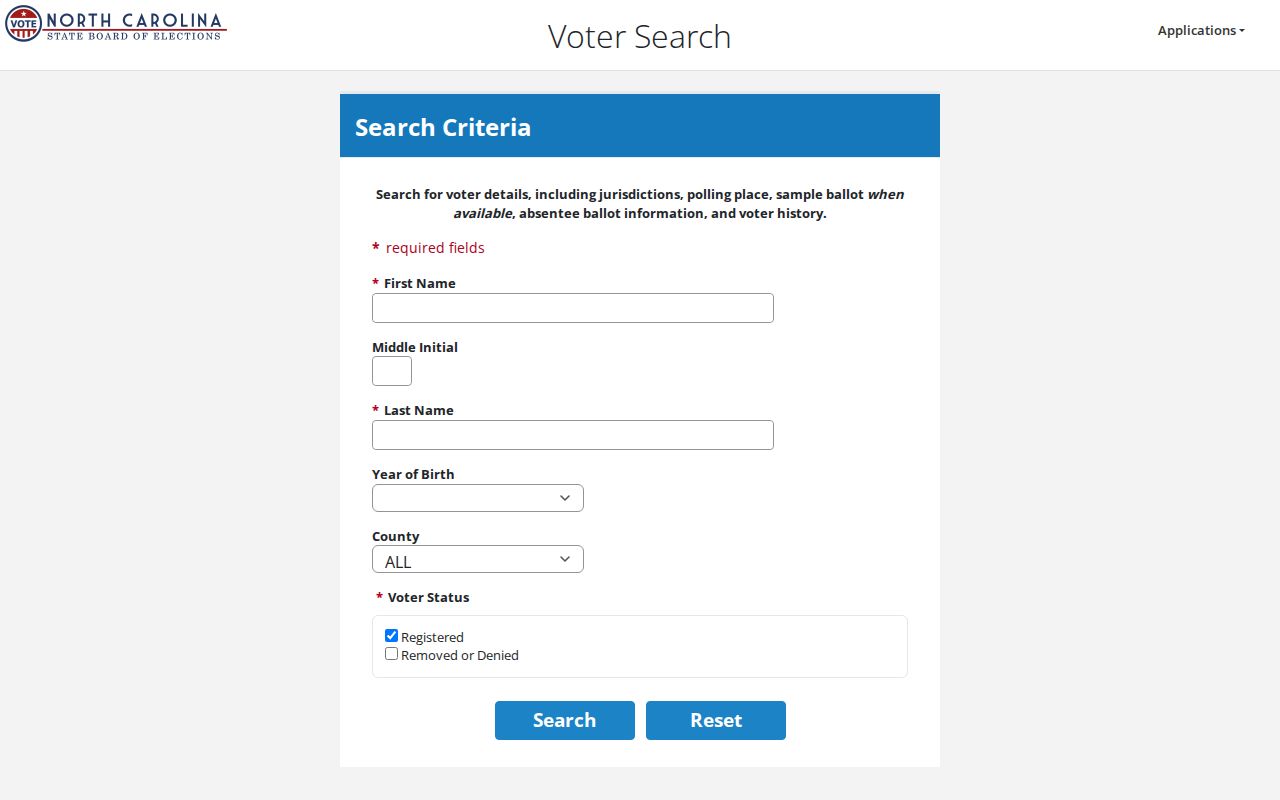
Full birth dates, identification numbers, voter-ID images, specified email data, signatures, and protected addresses are withheld or specially limited. The deeper voter-file fields and confidentiality rules belong in the Onslow County voter records lookup.
Browse Onslow Historical Directories
The Tucker Littleton Room at Jacksonville Main Library preserves a rare sequence of local people sources. Its holdings include Jacksonville newspapers from 1938 to the present, telephone books from 1957 to the present, and city directories from 1960 through 2019. It also provides census access, early local birth and death material, court minutes, land entries, marriage bonds and licenses, deeds, wills, tax lists, family-name files, and a microfilm reader.
Digital editions add a 1948 Carolina Publishing directory and Hill directories for 1957, 1960, and 1961. The 1961 volume includes a street-and-avenue guide arranged by street number. It lists occupants or businesses, marks owner versus renter status, and notes telephone status. That makes it a true reverse directory for an old Onslow address. The library genealogy database page also confirms HeritageQuest and in-library Ancestry access.
Current staff lists, older directories, and family-name files serve different tasks. A current school directory can reconnect a known public staff member. It is not an alumni list. Historical books and newspapers work better for classmates, former residents, and relatives who no longer appear in current records.
Note: Tucker Littleton Room copies cost $0.20 per page, while a remote genealogy request may carry a separate research fee.
Map Onslow Addresses Before Searching
Onslow GIS turns a parcel into geographic context. The county maintains cadastral parcels, E911 streets, zoning, flood zones, fire districts, schools, parks, and ZIP boundaries. Search by address, owner, or parcel where the viewer offers those controls, then identify the parcel and open linked tax or deed details. A map boundary is not proof of legal title, but it can keep a request from going to the wrong government.
The Onslow GIS and Property Mapping gateway leads to the county viewer and maintained layers. The interface shown below is especially useful when a Jacksonville mailing label hides a county location outside city limits.
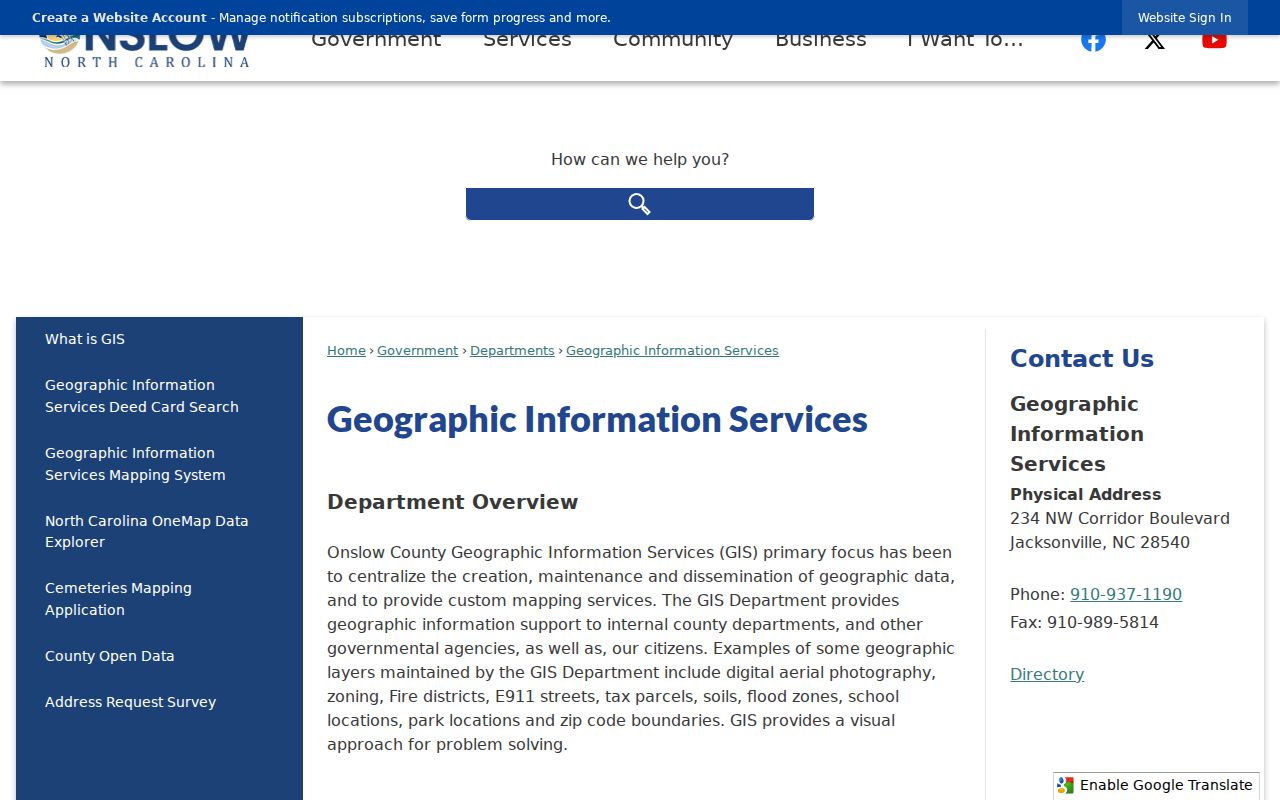
Jacksonville warns that a Jacksonville postal address does not prove residence inside the city. Check city limits, a city ward, the extraterritorial jurisdiction, and county layers before asking the City Clerk for a file. The same address can describe a postal route, a physical site, and a legal parcel in three different ways.
Note: GIS ownership can lag a recorded deed because several county departments process transfers, splits, and new subdivisions.
Check Onslow Custody Records
No stable public Onslow County jail roster was verified. For a current county booking, use the Detention Division fallback at 717 Court Street or call booking at 910-937-1470. State prison, probation, and parole records are different. The NC Department of Adult Correction search covers current and historical state data back to 1972 by name or offender identifier.
Results can include an offender number, name, demographic fields, status, prison or supervision location, admission and projected release information, offenses, dockets, sentences, and history. County jail data is not part of that state database. The SBI registry and federal locator also have their own scope and rules. Never use registry or address data to threaten, monitor, or harass a person.
Find Onslow Business Names
A business trail can connect an individual to an entity, registered agent address, filing, or assumed name. The North Carolina business registration search accepts organization and individual-name components. Entity profiles can show status, registered agent, officials, addresses, annual reports, and filings. The assumed-name database can filter by Onslow County and search owner names for filings made under the statewide system from December 1, 2017 forward.
Older assumed names require the Onslow Register of Deeds. Professional status is also split by board. Lawyers, physicians, nurses, contractors, and cosmetic arts licensees use separate official directories. A board result is a primary source for license status and discipline within that profession, while the Secretary of State record proves only what the business filing states.
Search Onslow Before the Web
Onslow County formed in 1734, but surviving material does not start in one neat year. State Archives miscellaneous records begin in 1732 with Brands from 1732 through 1741. Other groups include elections, citizenship, personal-property bills of sale, court minutes, courthouse-building papers, and nineteenth-century accounts. The county’s deed books begin in 1734, far earlier than its modern online name index.
The 1941 acquisition of land for Camp Lejeune created a distinct relocation trail. As Jacksonville’s small population rapidly grew, the Register of Deeds stayed open late to process condemnation and deed work. Those instruments, along with probate files and oral histories, can connect displaced families to former land. They are a human trail, not just a property list.
Jacksonville’s 1906 train-depot fire destroyed many town records, including volunteer-fire records. It was not a county courthouse fire. County court and deed survival must be checked series by series. The State Archives county record lists, Register of Deeds books, and local library holdings supply the fallback when a portal cannot.
Compare Official Onslow Search Sources
Official indexes answer narrow questions well. Commercial search tools combine many files and may surface a phone or address lead faster, but their data can be old, merged, or assigned to the wrong person. Use a commercial result as a pointer. Return to the custodian for the source record, its current status, and any certified copy.
| Source | Strength | Limit |
|---|---|---|
| County or state portal | Direct custodian data and defined fields | One record set and uneven historical coverage |
| Office counter or file | Older material and official copies | May require a visit, request, or fee |
| Library or archive | Past addresses, family links, and local context | Holdings vary by year and access |
| Commercial compilation | Broad lead gathering | Not a custodian and may be wrong |
Use records lawfully. Public access does not permit stalking, harassment, threats, identity theft, or harm. Verify identity before acting on a match.
When an Onslow Search Stops
A blank result can mean several things. The name may use a different spelling or middle initial. A person may have moved counties. The record may predate the web index, sit under a spouse or business name, remain in a paper file, or be sealed. An Address Confidentiality Program participant may use a substitute address. GIS and tax records may still be processing a recent deed.
Change one search fact at a time. Try the surname with fewer first-name characters, a former name, a known associate, a parcel ID, book and page, case number, or date range. Check Removed or Denied in voter search. Ask the office whether older books, microfilm, terminal access, or a specific request can reach the series. North Carolina Public Records Law does not require an agency to create a list that does not exist.
A true dead end should remain a dead end. Do not fill it with a guess. A careful Onslow County people search separates confirmed records, plausible links, and facts that the available sources cannot prove.